Important: This guide is for general information only and is not legal advice. Vaping laws change quickly, effective dates shift, and enforcement varies by state and even by city. Always confirm the current rules with your state's official department of health or attorney general before making any decision.
Not all vape bans are the same. Some states restrict which devices you can buy, some target where products are made, and some go straight at the thing regulators say drives youth use: flavor. This guide covers that last category specifically - the states that have banned or restricted flavored vaping products, and the fast-moving detail that trips everyone up: menthol.
If you want the wider picture, including disposable bans and product directories, see our companion guide to the 2026 vape ban state-by-state. This article zooms in on the flavor angle.
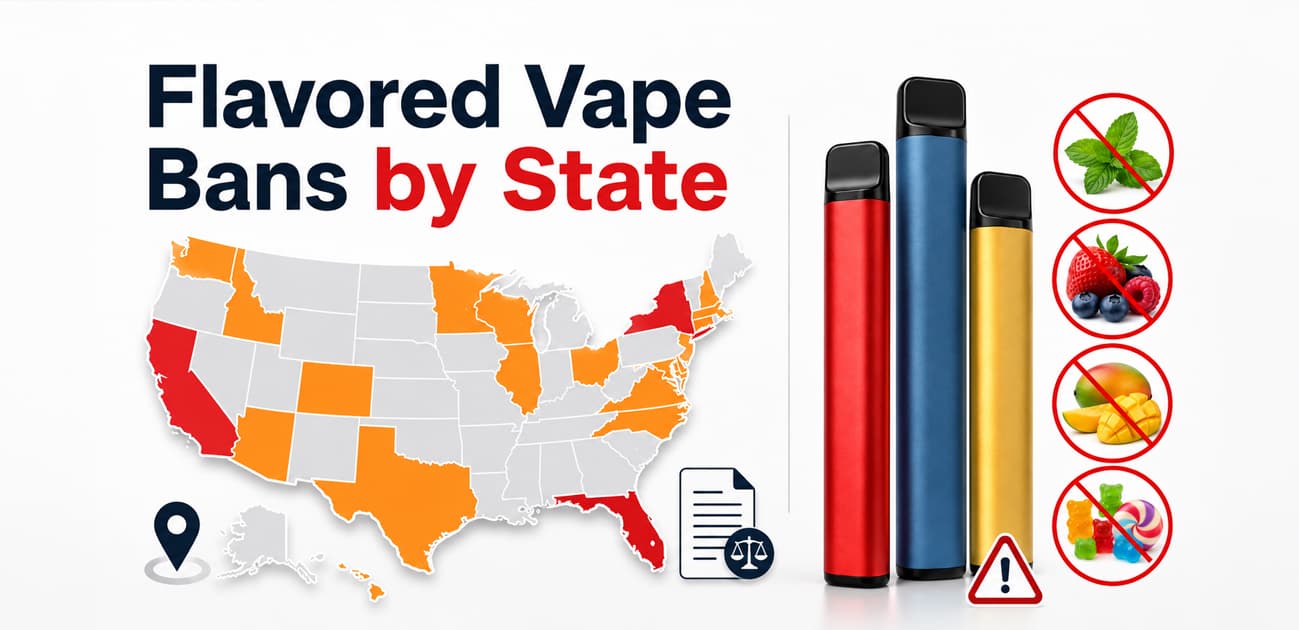
As of 2026, five states have comprehensive flavored vape bans: California, Massachusetts, New Jersey, New York, and Rhode Island. Others - including Colorado, Oregon, Washington, and Utah - have partial or narrower flavor restrictions. Whether menthol is included varies by state and is actively changing. Tobacco-flavored products are usually the exception that stays legal.
How flavor bans actually work
A "flavored vape ban" almost always restricts the sale and distribution of flavored products within a state - not personal possession. The typical structure is a ban on selling any vape in a flavor other than tobacco, sometimes with a menthol exception (though those exceptions are shrinking).
Three things are worth understanding up front:
- Tobacco is the usual exception. Most flavor bans leave tobacco-flavored products legal, since the goal is to remove the sweet and minty profiles regulators associate with youth use.
- Menthol is the wildcard. Some states include it, some exempt it, and several are moving from exempting to including it. This is the single most confusing part of the map.
- Cities can go further than states. Local governments sometimes add their own restrictions, so a city may ban more than its state does. San Francisco, for example, restricts vape sales more tightly than California as a whole.
The 5 full flavor-ban states
These states have the most sweeping flavor restrictions in the country. In each, a legally manufactured, brand-name vape is still prohibited from sale if it carries a restricted flavor.
-
Full ban
California
The strictest in the nation, and it tightened further in 2026. Building on Proposition 31 (upheld by voters in 2022), newer rules that took effect January 1, 2026 mean only products on the state's approved Unflavored Tobacco List can be sold. The ban covers fruit, candy, mint, dessert, menthol, and even products with a "cooling sensation" designed to mimic menthol. Online sales shipping to California addresses fall under the ban too, and separate legislation restricts disposables broadly.
-
Full ban
Massachusetts
One of the earliest comprehensive flavor bans, in effect since 2020, and among the strictest. It includes menthol. Flavored products are effectively restricted out of ordinary retail, and the state runs one of the tightest tobacco and vaping regulatory systems in the country.
-
Full ban
New Jersey
One of the earliest states to impose a permanent ban on flavored vapor products, dating to 2020. It prohibits the sale and distribution of flavored vapes, and menthol - initially a gray area - has moved into the restricted column. Tobacco-flavored products may remain available, but the flavored market is heavily restricted.
-
Full ban
New York
Remains one of the most difficult markets for flavored products. New York bans flavored vapes other than tobacco, and the menthol exemption that once existed has been narrowing in practice, with legislation aimed at closing it entirely. Online sales of flavored products into the state are prohibited.
-
Full ban
Rhode Island
Rhode Island's flavored vape ban was enforced and made permanent at the start of 2026, building on an earlier executive order. It bans flavored vaping products, and like its neighbors, its menthol exemption has been moving toward removal. As with several states, there has been ongoing legislative back-and-forth, which is exactly why current-status checks matter.
Colorado is often grouped here too. Colorado has had flavor restrictions in effect since 2024 and is sometimes counted among the full-ban states depending on how strictly its rules are read. If you are in Colorado, treat it as a restricted market and verify the specifics locally.
The menthol question
If there is one thing to take away from this guide, it is that menthol is the most unstable part of the flavor-ban map - and the detail most likely to catch people out.
Here is the current picture. California and Massachusetts include menthol in their bans outright. New Jersey, New York, Rhode Island, and Utah initially exempted menthol - meaning menthol vapes stayed legal when other flavors were banned - but have since removed or are in the process of removing those exemptions. The direction of travel is clearly toward including menthol rather than exempting it.
Why does menthol get special treatment? It sits at the center of a public-health debate about equity and youth use that fruit and candy flavors do not, which is why lawmakers handle it separately - and why its status keeps shifting. For the flavor category itself, our guide to the best mint and menthol vapes covers the products, though availability depends entirely on your state.
Do not assume menthol is safe in a "flavor ban" state. Because the exemptions are actively being removed, a menthol product that was legal in your state last year may not be now. This is the one detail worth double-checking against an official source every single time.
Partial and emerging restrictions
Beyond the five comprehensive-ban states, a growing group has enacted narrower flavor restrictions. The details differ, but the trend is unmistakably toward more regulation, not less.
-
Partial
Oregon
Enacted a comprehensive flavor ban in 2024 covering flavored e-cigarettes. Online sales of flavored products into the state are effectively prohibited.
-
Partial
Washington
Enacted flavor restrictions in 2024. As with other restricted states, the specifics and enforcement continue to evolve.
-
Partial
Utah
Restricted flavored vapes (with tobacco, and initially menthol, as exceptions), limiting them largely to licensed specialty shops. The ban was challenged in court but upheld by a federal judge in 2026, and the menthol exemption has been moving toward removal.
-
Partial
Colorado
Flavor restrictions in effect since 2024. Depending on interpretation, Colorado is sometimes listed among the full-ban states - another reason to verify locally.
-
Partial
Washington DC
Follows a model comparable to the comprehensive-ban states, with sweeping restrictions on flavored products.
Directory states: the indirect ban
Some states do not ban flavors by name, yet still remove most flavored products from shelves. These are directory (or registry) states: they restrict sales to a state-approved list of products, and because that list is tied to federal authorization - which almost no flavored disposable currently has - the practical effect is that most flavored disposables become illegal to sell.
States using this model include Florida, North Carolina, Wisconsin, Tennessee, and Mississippi, among others. If you are in one of these states, you may not see a "flavor ban" on the books, but your flavored options can be just as limited. We cover how directories work in detail in the state-by-state vape ban guide.
Why states target flavors
Flavor bans are not arbitrary - regulators cite a consistent set of reasons for singling out flavor specifically rather than vaping in general:
- Youth access. The most-cited concern. National survey data has repeatedly shown that the large majority of young people who vape use flavored products, which lawmakers read as evidence that sweet and minty flavors drive underage initiation.
- Health equity. Menthol in particular is tied to a longstanding equity debate about how it has been marketed to specific communities over decades, which is why it is often treated as its own policy question.
- Public health outcomes. Officials point to reported outcomes in areas that adopted flavor restrictions as justification for expanding them.
You do not have to agree with the policy to benefit from understanding the reasoning - it explains why flavor, and menthol especially, keeps drawing focused legislation while tobacco-flavored products are generally left alone.
What it means for buying online
The practical takeaway for shoppers is straightforward. In a flavor-ban state, online sales of flavored products are effectively prohibited - the ban applies to products shipped to your address just as it does to a physical store, and compliant retailers block those orders at checkout based on your shipping location.
Buying from an out-of-state retailer does not exempt you from your own state's law, and federal PACT Act rules add another layer of requirements to all online vape shipping, including age verification and adult-signature delivery. Any retailer claiming to ship any flavor to any state is not operating compliantly.
The honest bottom line: If you live in a flavor-ban state, tobacco-flavored and other authorized products are generally the legal route, and your options for flavored disposables are limited by design. The rules exist at the state level, and no online workaround changes what is legal to sell to your address.
Summary table
A snapshot as of July 2026. Treat this as a starting point, not the final word - verify your state's current status before relying on it.
| State | Type | Menthol status |
|---|---|---|
| California | Full flavor ban | Included in ban |
| Massachusetts | Full flavor ban | Included in ban |
| New Jersey | Full flavor ban | Exemption removed / removing |
| New York | Full flavor ban | Exemption narrowing |
| Rhode Island | Full flavor ban | Exemption removed / removing |
| Colorado | Restrictions (2024) | Check locally |
| Oregon | Flavor ban (2024) | Check locally |
| Washington | Restrictions (2024) | Check locally |
| Utah | Restrictions, specialty-only | Exemption removing |
| Washington DC | Comprehensive model | Check locally |
| FL, NC, WI, TN, MS | Directory (indirect) | Most flavors removed in practice |
Everywhere else: Roughly twenty states have no statewide flavor ban and minimal vaping-specific regulation beyond the federal age-21 rule - though local city or county restrictions can still apply. If your state is not listed above, flavored products are generally available, but a quick local check is always worth it.
FAQ
Five states have comprehensive statewide flavored vape bans: California, Massachusetts, New Jersey, New York, and Rhode Island. Several others have partial or narrower restrictions, including Colorado, Oregon, Washington, and Utah, plus Washington DC. Directory states like Florida and North Carolina do not ban flavors by name but effectively remove most flavored disposables from sale.
It varies and it is actively changing. California and Massachusetts include menthol. New Jersey, New York, Rhode Island, and Utah initially exempted menthol but have since removed or are removing those exemptions. Because menthol is the fastest-shifting part of these laws, always check the current status in your state.
Generally no. In ban states, online sales of flavored products to in-state addresses are prohibited under the same rules as in-store sales, and compliant retailers block those orders at checkout. Federal PACT Act rules also govern online vape shipping. Buying out of state does not exempt you from your own state's law.
Usually yes. Most flavor bans leave tobacco-flavored products legal, since the intent is to remove the sweet, fruity, and minty profiles. Authorized tobacco (and, where still exempt, menthol) products are typically the legal route in restricted states, though you should confirm against your state's approved list.
States cite youth access, since most young people who vape use flavored products; health equity concerns, especially around menthol; and reported public health outcomes in areas with restrictions. Flavor is targeted because it is viewed as a key driver of youth initiation, which is why tobacco flavors are generally left alone.
This article is informational only and not legal advice. Vaping laws and effective dates change frequently and vary by state and locality. Always verify current rules with your state's department of health or attorney general. This product category contains nicotine. Nicotine is an addictive chemical. For adults 21+ only.